Exploring Boundless Potential: AI Revolutionizes Oncology at ASCO 2023
Exploring Boundless Potential
AI Revolutionizes Oncology at ASCO 2023
by Gayathri Raghupathy
As a company artistically merging the realms of science and technology, we at Kognitic, were naturally drawn to the application of “AI in oncology” at the ASCO 2023 meeting. We felt that we were amidst remarkable advancements in patient care, embarking on a transformative era where AI plays a pivotal role in the field of oncology. AI is transforming oncology across every stage, from R&D and clinical trials to cancer diagnosis, clinical decision support, outcome prediction, and more. While significant progress has been made, key decision-making functions like commercial strategy, competitive intelligence, and global marketing still require advancements. Kognitic stands at the forefront, filling this void and we were delighted to showcase these impactful solutions at the ASCO meeting. Witnessing the representation of diverse areas in oncology influenced by AI at the ASCO 2023 conference was nothing short of fascinating, and below is a quick recap of key takeaways!
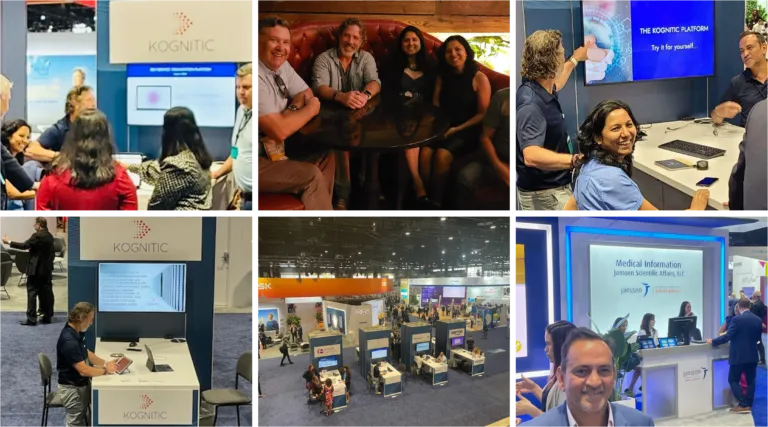
Exhibits: The event brimmed with vibrant exhibits, thought-provoking panel discussions, cutting-edge product launches, and captivating posters that showcased the remarkable progress made in integrating AI into existing processes. The exhibits presented by renowned AI and technology companies, including Tempus, Concert AI, medidata, Massive BIO, Syneos Health, Certara, and Flatiron, sparkled with exciting conversations and the potential for promising partnerships. Notably, Tempus and Massive BIO unveiled groundbreaking product launches that harnessed the power of Generative-AI, giving birth to “chat assistants” designed to support clinical decisions and expand access to trials, respectively. Additionally, the newly established “innovation hub” served as a perfect platform for novel AI-companies such as Kognitic to showcase technological advancements
Abstracts: Among the 5000+ abstracts presented at the conference, a remarkable 114 abstracts shared their findings on “artificial intelligence”. We, at Kognitic, took great pride in contributing two abstracts in this category (Oncology outlook and Racial disparity in Clinical trials). Through our perusal of these abstracts, we discovered the diverse applications of AI in oncology, as listed below:
-
-
Cancer diagnosis
- Assessment of cancer risk
- Early cancer diagnosis
- Digital pathology
-
Treatment and prediction
- Decision support tools to predict treatment algorithm and potential treatment failures
- Phenotypic personalized medicine
- Predict treatment initiation
- Predict treatment outcomes
- Predict adverse events, specifically immune-related adverse events or toxicities
- Predict risk of cancer recurrence
-
RWD
- Processes to extract specific information, such as line of therapy from claims or medical documents
- Medicase cost analysis
-
Clinical trials
- in-silico patient selection or enrichment
- Design of biomarker-driven trials
- Build models to test efficacies of mono vs combinatorial therapies
- Drive patient enrollment in trials with an emphasis on addressing racial disparity
-
Specifically, we noticed the abundance of abstracts focused on “digital pathology.” Innovations ranged from workflows in creating “digital slides” to alleviate the laboriousness and inconsistencies associated with manual classification processes and the development of models to accurately determine intricate details like mutational scores (PD-L1 CPS scores). Notably, companies like Path.ai (our ‘neighbor’ at the innovation hub) are doing groundbreaking work in this space, further underscoring the potential of AI in revolutionizing pathology.
Presentations: While numerous companies and academic institutions are fervently pursuing advancements in specific areas, there is also a growing emphasis on a holistic approach that aims to provide personalized care for patients. For instance, I3Lung, presented by the brilliant Arsela Prelaj, emerged as an exemplary initiative that integrates multiomics data from various sources within the healthcare system, including clinical, pathological, genomics, metablonomic, radiology, and real-world data. This fusion of diverse data sources empowers clinicians to make highly personalized treatment decisions.
Additionally, Dr. Ho delivered an exceptional presentation on curate.AI, a decision-support tool that predicts the ideal drug combination and dosage levels for patients throughout their treatment journey.
Summary: Overall, our experience at ASCO left an indelible impression. While the excitement surrounding “intelligent oncology” is palpable, stakeholders and innovators remain cautiously optimistic, prioritizing the establishment of responsible practices in machine learning and AI modeling. At Kognitic, we left ASCO with a resonating quote from Dr. Ho, encapsulating the essence of truly personalized care: “We are different from each other. We are also different from ourselves over time.” This powerful reminder highlights the uniqueness of each patient and underscores the importance of tailoring treatments to their evolving needs.
For more information, email info@kognitic.com
Copyright© 2023 Kognitic, inc. All rights reserved.*